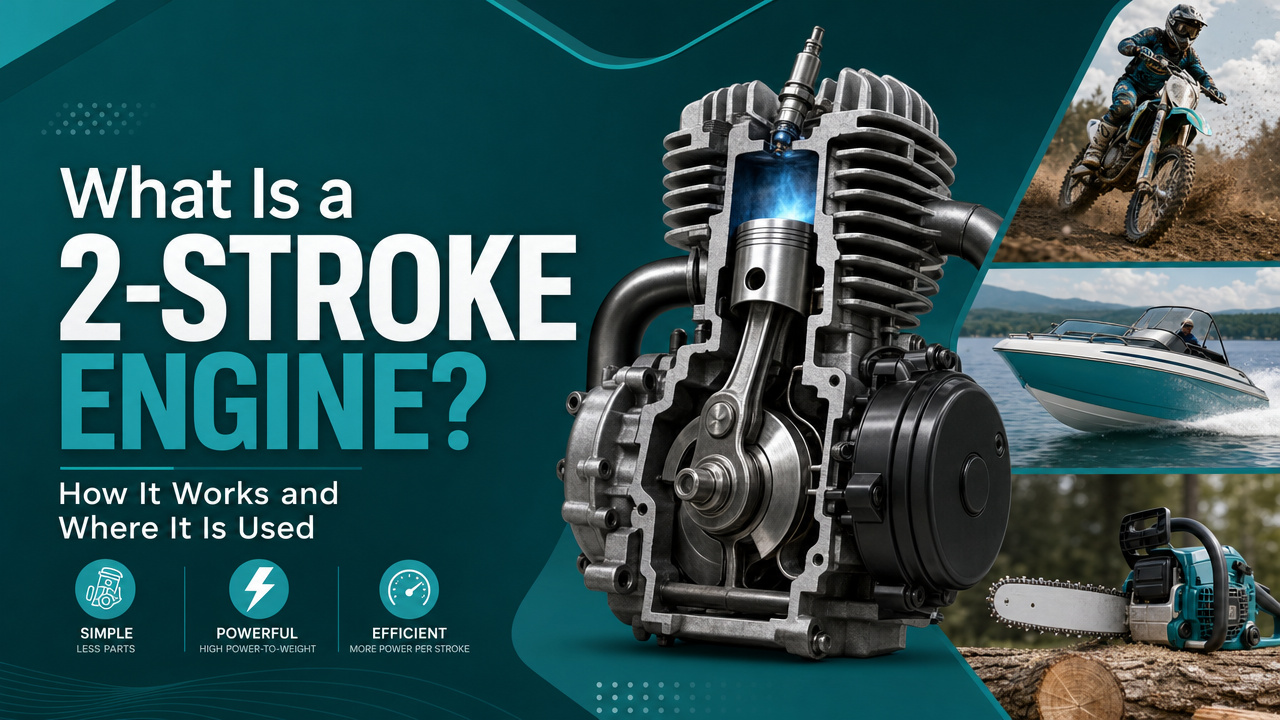
The 2-stroke engine remains a cornerstone of compact, high-power-density machinery. From marine outboards to handheld landscaping tools, its mechanical simplicity delivers performance where weight and size matter. This article breaks down how a 2-stroke engine works, where it is used, and why lubrication selection defines its lifespan.
A 2-stroke engine is an internal combustion engine that completes a power cycle in two piston movements, one upward and one downward, corresponding to a single crankshaft revolution. This is what 2-stroke means in mechanical terms, a full combustion cycle in half the strokes of a conventional engine.
Unlike its 4-cycle counterpart, a two stroke engine combines intake, compression, power, and exhaust into overlapping events. The crankcase itself participates in the intake and scavenging process, drawing the fuel-air-oil mixture through a reed valve before transfer into the combustion chamber.
This design eliminates dedicated intake and exhaust strokes. The result is a lighter, mechanically simpler unit with fewer moving parts, no valve train, no camshaft, and a higher power-to-weight ratio than equivalent 4-stroke designs.
The two strokes in a 2-stroke engine are the compression stroke and the power stroke. Each stroke handles multiple functions simultaneously, which is what defines the two cycle engine workings.
Compression Stroke — As the piston rises, it compresses the fuel-air mixture in the combustion chamber. Simultaneously, a vacuum forms in the crankcase below, drawing a fresh charge through the reed valve. Near top dead center, the spark plug ignites the compressed mixture.
Power Stroke — Combustion drives the piston down, transferring energy to the crankshaft. As the piston descends, it pressurizes the crankcase charge. Near bottom dead center, the exhaust port opens to release spent gases while the transfer port admits the fresh charge, completing the scavenging process.
This overlap between exhaust discharge and fresh charge intake is the defining trait of two stroke engine mechanics. Efficient scavenging directly influences power output, fuel economy in 2-cycle engines, and emissions.
The core difference between 2-stroke and 4-stroke engines lies in cycle completion. A 4-stroke fires once every two crankshaft revolutions, while a 2-stroke fires every revolution, effectively doubling the power pulses at identical RPM.
The 2-stroke vs 4-stroke choice ultimately hinges on the application. Where weight, cost, and power density matter, 2-strokes dominate. Where longevity, fuel economy, and emissions matter, 4-strokes lead.
2-stroke engines are used wherever compact power and mechanical simplicity outweigh emissions concerns. Their applications span marine, recreational, industrial, and landscaping sectors.
2-Stroke Outboard Motors — Marine outboards leverage the high power-to-weight ratio for propulsion. Water-cooled two stroke oil formulations meeting NMMA TC-W3 specifications protect against corrosion, ring sticking, and exhaust deposits in wet operating conditions.
Chainsaw 2-Cycle Engine — Handheld cutting tools require operation at any angle, impossible with a wet-sump 4-stroke. Air-cooled 2-stroke engine oil meeting JASO FD provides clean burning and low smoke performance under high RPM loads.
2-Stroke Dirt Bike Engines — Motocross and enduro machines rely on the aggressive power delivery of 2-strokes. High performance 2-stroke lubricants with full synthetic premix formulations protect at extreme thermal loads.
Scooter 2-Stroke Engine — Small displacement scooters in emerging markets still use 2-strokes for affordability and torque delivery in urban environments.
Additional applications include snowmobiles, weed eaters, leaf blowers, jet skis, model engines, and industrial 2-stroke oil applications in stationary equipment.
2-stroke engines have no oil sump. The crankcase serves as an induction chamber, not a lubrication reservoir. This means the piston, rings, bearings, and cylinder wall must be lubricated by oil delivered with the fuel charge itself, this is the essence of crankcase lubrication in two-stroke design.
Premix — Oil is blended directly with gasoline at a specified fuel to oil ratio, commonly 50:1, 40:1, or 32:1 depending on the manufacturer. Pre-mixed 2-cycle fuel enters the crankcase, coats internal surfaces, then burns in the combustion chamber.
Oil Injection — Modern engines use a 2-stroke oil injection system with an oil injection reservoir fluid pumped in metered amounts relative to throttle position. This eliminates the need for gasoline to oil mixture calculation and reduces smoke at low loads.
Premix vs injected oil comes down to application. Racing engines and older equipment use premix for consistency. Marine outboards and modern scooters use injection for convenience and reduced emissions.
Choosing the right 2-cycle oil, whether mineral 2-stroke oil, semi synthetic 2-cycle oil, or full synthetic premix, depends on the operating environment. Synthetic vs conventional 2-stroke oil trade-offs involve cost, thermal stability, and oxidation stability. TC-W3 outboard oil should never be substituted for JASO FD chainsaw oil, and vice versa.
Premium ashless formulations with anti wear additives prevent spark plug fouling, ring sticking prevention, and minimizing combustion chamber deposits. The right lubricant for 2-stroke outboard, dirt bike, or landscaping equipment directly extends engine life.
The 2-stroke engine's strengths and weaknesses stem from the same design principles. Its simplicity delivers advantages that no 4-stroke can match, but at measurable costs.
Reducing emissions in two stroke engines and preventing exhaust blockages both depend heavily on lubricant quality. Low smoke formula oils with clean burning oil chemistry mitigate the traditional drawbacks and support maximizing 2-stroke engine life.
Armor Lubricants formulates OEM approved 2 stroke oils engineered for marine, motorcycle, and landscaping applications. Whether the requirement is TC-W3 outboard oil, JASO FD chainsaw lubricant, or premium 2-cycle engine oil for high RPM bearing lubrication, matching the specification to the equipment ensures maximum wear protection, friction reduction, and equipment protection across every duty cycle.